New Approaches to Ancient Floor Mosaics
Journée d’études
12 décembre
CO-ORGANISED BY KOMAIT ABDALLAH (AOROC-CNRS, PARIS) AND SEAN
LEATHERBURY (UCD SCHOOL OF ART HISTORY AND CULTURAL POLICY)
Mosaics, functional works of art made of stone and glass, decorated the homes of the wealthy, public buildings, tombs, and places of worship all around the ancient Mediterranean. These works are key pieces of evidence in reconstructing the lives, tastes, and values of ancient peoples in times of cultural, social, political, and religious transition. Gathering together archaeologists and art historians who work on the
mosaics of the Hellenistic, Roman, and Late Antique Mediterranean, this conference explores new approaches to mosaic floors.
Overview
Mosaics, functional works of art made of stone and glass, decorated the homes of the wealthy, public
buildings, tombs, and places of worship all around the ancient Mediterranean. These works are key pieces of evidence in reconstructing the lives, tastes, and values of ancient peoples in times of cultural, social, political, and religious transition. Gathering together archaeologists and art historians who work on the mosaics of the Hellenistic, Roman, and Late Antique Mediterranean, this conference explores new approaches to mosaic floors.
Speakers include
Komait Abdallah (Paris) ; Karen Britt (Northwest Missouri State) ; ProletDecheva (Dublin) ; Nathan Dennis(San Francisco) ; KutalmısGorkay (Oxford) ; Ayman Hassouna (Gaza/Dublin) ; Nada Helou (Beirut) ;Amina-Aïcha Malek (Paris) ; Eric Morvillez (Avignon) ; Hatice Pamir (Antakya) ; Houmam Saad (Paris/Damascus) ; Mustafa Şahin and DeryaŞahin (Bursa) ; Will Wootton (London)CO-ORGANISED
ONLINE
Conference ScheduleFriday, 12 December
9:00–9:30 Coffee/Tea
9:30 Welcome Remarks (Sean Leatherbury, Komait Abdallah)
9:45–11:30 Session 1 : Allegory, Symbolism, and Local Contexts
Chair : Will Wootton
KutalmışGörkay (Oxford) : Allegory and Symbolism : The Mosaics, Patrons, and Inhabitants of the
Houses of Zeugma
Komait Abdallah (AOROC-CNRS Paris) and Houmam Saad (École Pratique des Hautes Études –
PSL) : Studying Mosaics in their Temporal and Geographical Context : Case Study : The Recently
Discovered Al-Rastan Mosaic in Syria
ProletDecheva (Dublin) : An Allegory of Luxury and Abundance : The Mosaics of the Episkopeion at
Olympos
11:30–11:45 Coffee
11:45–1:00 Session 2 : Iconographic Approaches
Chair : Komait Abdallah
Amina-Aïcha Malek (CNRS Paris) : Dionysos, or the Contradiction United by the Vine in Ancient North
Africa
Nada Helou (Université Libanaise, Beirut) : The Newly Discovered Mosaic Pavements in Beirut
1:00–2:00 Lunch [speakers only]
2:00-2:30 Tour of UCD Classics Museum (Newman K216) [speakers only]
2:45–4:00 Session 3 : Making and Meaning
Chair : Nathan Dennis
Will Wootton (King’s College London) : ’Making It’ : Exploring Roman Mosaic Techniques through
Practical Experiments
Karen Britt (Northwest Missouri State University) : All that Glitters is Not Gold : Color and Light in
the Huqoq Synagogue Mosaics
4:00–4:15 Coffee
4:15–6:00 Session 4 : Mosaics and Social Class
Chair : ProletDecheva
Nathan Dennis (University of San Francisco) : In Loo of Luxury : Class and Status in the Mosaic
Decoration of Roman Toilets
Sean Leatherbury (UCD) : Late Antique Mosaics, Inscriptions, and Donors Revisited : From Individuals
to Communities
Ayman Hassouna (Islamic University of Gaza/UCD) : The Mosaic School in Gaza and Its Illustration
of the Civilized Life of Gaza Society
8:00 Conference Dinner, Dunne & Crescenzi, 14-16 South Frederick Street [speakers only]
Conference Schedule
Saturday, 13 December
9:30-10:00 Coffee
10:00-11:45 Session 5 : New Approaches to the Mosaics of Turkey
Chair : Sean Leatherbury
Eric Morvillez (Avignon) : Contextualizing the Mosaics of the House of Iphigenia in Antioch : The
Contribution of Excavation Archives
Hatice Pamir (Mustafa Kemal University, Antakya) : Living in the Houses of the Wealthy : New Mosaic
Discoveries in Antakya (Antioch on the Orontes) and Harbiye (Daphne)
Mustafa Şahin and DeryaŞahin (Bursa Uludağ University) : Sinope Mosaics : A Bridge in the Transfer of
Mosaic Art to the West [Zoom]
11:45-12:00 Closing Remarks
12:00-1:00 Lunch [speakers only]
2:00-3:00 Visit to National Museum of Ireland - Archaeology, Kildare Street [speakers only]
Abstracts
Komait Abdallah (AOROC-CNRS) and Houmam Saad (EPHE-PSL, Université de Damas)
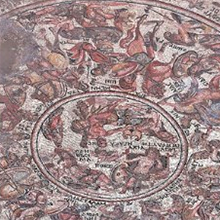
Studying Mosaics in Their Temporal and Geographical Context : Case Study : The Recently Discovered Al-Rastan Mosaic in SyriaIn 2022, we discovered a mosaic beneath the dwellings in the city of Al-Rastan near Homs, called Arethusa in Antiquity. This mosaic presents a truly exceptional iconographic program, composed of two figurative panels framed by a geometric border. The first panel depicts the theme of the wedding procession of Poseidon and Amymone, surrounded by a marine thiasos. The second panel features a scene of Amazonomachy in two circles and four couples of seasons and wind gods in the four spandrels. Excavations carried out in 2023 in the same area led to the discovery of a third panel depicting a centauromachy scene. The stylistic study of this mosaic led us to date it to the third quarter of the 4th century AD. This dating was confirmed by two coins, found in the excavations, dating back to the emperors Constantius (337-361) and Julian (362-364). It is interesting to notice that, at the same time, the city of Arethusa knew a historical event well documented by the fathers of the churches in Syria. This is the story of the city’s bishop Markus who provoked the anger of the pagan community by destroying the main temple during the reign of Constantius II. Julian’s rise to power and his policy of establishing paganism, especially in the East, encouraged the predominantly pagan population to punish the bishop by subjecting him to unbearable torture. In this presentation we will try to see if there is a link between the iconographic program illustrated on the mosaic and the reaction of the pagans in the city towards Bishop Markus and the Christianization of the region.
Karen Britt (Northwest Missouri State University)
All that Glitters is not Gold : Color and Light in the Huqoq Synagogue Mosaics
Abstract : Over the past twenty years, numerous studies have built meaningfully on Liz James’ seminal article “Color and Meaning in Byzantium,” in which she argued that color—varied, lustrous, and luminous—was an essential element of the aesthetic experience in religious environments. While mosaics have figured prominently in discussions of the role played by color in architectural decoration, the focus has been primarily on the glittering, often golden, wall, vault, and dome mosaics. Fewer, studies have investigated the use of color in floor mosaics despite their frequent appearance in late antique synagogues and churches of the eastern Mediterranean. The well-preserved biblical and nonbiblical scenes uncovered by Jodi Magness and her team in the late fourth/early fifth century synagogue at Huqoq in lower eastern Galilee attest to the manifold and sophisticated use of color in floor mosaics. This paper uses the Huqoq mosaics as a springboard to first examine how color and light were employed to invite members of religious communities into the images depicted in floor mosaics. Next, it is proposed that a viewer’s experience of color in floor mosaics diverged from their experience of color on walls, vaults and domes due to the different, and arguably more intimate, nature of their engagement with the floor.
ProletDecheva (Independent Researcher, Dublin)
An Allegory of Luxury and Abundance : The Mosaics of the Episkopeion at Olympos
Abstract : Recent excavation on the site of the Episcopal Palace at Olympos, in the southwest of Asia
Minor, have revealed interesting mosaic arrangements, dated to the 6 century AD, including geometric floors, animals, and figural mosaics such as multiple personifications of abstract concepts. The majority of the latter are identifiable as via Greek name labels as Ktisis (“Foundation”), Charis (“Grace”), Tryphe (“Luxury”) and Apolausis (“Enjoyment”) and include a composite figure with a three-fold name label combining some of the already personified concepts in a sole figure as Ktisis – Charis – Ananeosis (“Renewal”). While the individual personifications are not unique but are instead among some of the most popular in the late antique Eastern Mediterranean and can be associated with the lavish lifestyle and attitudes of the elites, their combination on the floors of the Episkopeion is so-far unique. Further imagery on the site can also be linked to the expression of abundance and an aristocratic lifestyle : servants carrying dishes, a hunting scene, figures associated with the fecundity of the earth and others.The present paper will situate the mosaics at Olympos within the larger context of similar imagery in the late antique Eastern Mediterranean and discuss their roles within the elite representation of late antique bishops.
Nathan Dennis (University of San Francisco)
In Loo of Luxury : Class and Status in the Mosaic Decoration of Roman Toilets
Abstract : Roman latrines were the great democratizers of Roman social class. High-born or low, patrician or freedman, local citizen or foreigner on business, if nature called while working within or strolling through the Roman urbs, then you typically relieved yourself alongside everyone else in a communal space with little to no privacy. Not all latrines were alike, however. Quality, cleanliness, decor, and, to some degree, privacy and discretion, varied considerably depending on the location within the city. They also depended on whether the latrine was designed for larger-capacity use (and therefore maximally public) or was attached to a smaller business or shared domestic space such as an apartment block, which afforded more privacy due to lower-capacity design. The lowly Roman toilet, therefore, is a remarkable space for studying social stratification, particularly when literary references, graffiti and inscriptions, or interior decoration offer additional clues about how latrine patrons, designers, and daily users understood their social roles in one or Rome’s most mundane architectural constructs. Historically, discussions of Roman latrines have focused primarily on wastewater management systems, including hydraulics and hydrology, that helped maintain appropriate standards of civic hygiene to mitigate outbreaks of infectious disease. More recently, scholars have turned to the more scatological and salacious references to latrines and bodily waste in Greek and Roman literature and graffiti as both mirror of daily life and social metaphor. But comparatively little has been said of how Roman toilets were decorated. Design and iconography could be leveraged to reinforce social expectations of class and status in the Roman toilet just as easily as they could reflect the anxieties, fears, and vulnerabilities of public exposure. Mosaic pavements, in particular, were a convenient medium for exploring those themes. Of the thousands of latrines that once existed across Roman cities, precious few have survived with their decoration intact. Yet enough examples are available to make some preliminary conclusions on design trends and their social implications within public and private toilets, where low-brow humor and witty mockery, sexual transgression and amorous rendezvous, or pop culture icons and lofty ideals of the Roman elite were expressed for the benefit of specific audiences. Figural and/or mythological scenes at public toilets in Antiochia ad Cragum, Aquinum, Bolsena, Ostia, or Timgad, for instance, depict low-brow humor of bawdy sexual escapades or even sexual violence. These scenes projected the inherent vulnerabilities experienced in the public latrine while simultaneously mocking those anxieties or deflating them as carnivalesque celebrations of the scatological and sexual, a theme commonly expressed in latrine graffiti and Roman poetry alike. By contrast, private toilets, such as those at House II in Ephesus, the Domus Tiberiana in Rome, or the Villa Romana del Casale in Piazza Armerina, display iconography more consistent with the educated elite or which highlight the social expectations of Roman virtus that was expected of Rome’s aristocratic class. This paper will examine the broader implications of Roman social stratification in the decorative commissions for public and private latrines, especially since public infrastructure was often funded and overseen by private benefactors, not the Roman state.
KutalmışGörkay (Oxford)
Allegory and Symbolism : The Mosaics, Patrons, and Inhabitants of the Houses of Zeugma
Abstract : Recent research on the figurative mosaics in the Roman houses at Zeugma has illuminated new dimensions of the relationship between mosaics, their patrons, and the inhabitants of these domestic spaces. A particularly revealing case is a mosaic inscription uncovered during the salvage excavations at Zeugma, set within a tabula on a pavement decorated with geometric patterns. This inscription, composed in Greek in dactylic hexameter, takes the form of an epithalamium commemorating the marriage of two individuals, possibly named Proteas and Artemidora, who appear to have been related by kinship. The poem’s central motif is a call for the couple to produce offspring, thereby ensuring continuity within the family line. If this inscription reflects highly personal preferences and messages connected to the living inhabitants of the house, then it raises the question of whether other mosaic depictions within these residences might also have conveyed similarly subtle meanings. By situating this inscription within the broader cultural and architectural context of Roman Zeugma, this paper aims to explore the allegorical and symbolic dimensions of such mosaic programs in the other houses at Zeugma, shedding light on how literary traditions, social expectations, and domestic display intersected in the lived experience of the ancient household.
Ayman Hassouna (Islamic University of Gaza/UCD)
The Mosaic School in Gaza and Its illustrated of the Civilized Life of Gazan Society
Abstract : It is known that the Gaza city and its surroundings witnessed economic prosperity and security stability during the Byzantine period, which was reflected in the culture in the fifth and sixth centuries AD.The reputation and fame of the various schools of Gaza, especially in rhetoric, was well-known and rivalled the schools of Athens. It is not unlikely that an architectural school would flourish in Gaza, especially in the art of mosaics. The reputation and fame of the various schools of Gaza, especially in rhetoric, was well-known and rivalled the schools of Athens. It is not unlikely that an architectural school would flourish in Gaza, especially in the art of mosaics. This is evidenced by the remains of many church mosaic pavements discovered in Gazaand its surrounded, so in this research we will try to highlight the most prominent artistic features.This study search various cultural aspects that flourished in Gaza during the Byzantine period, which were implemented on mosaics and decorated the floors of churches in Gaza and its surroundings, such as wild and pets animal figures, geometric and plant decorations, and types of food and deferent pots that distinguished in the kitchen of Gazan society, which reflect the cultural advancement in Gaza during that period.The study is based on four mosaic pavements as examples : Al- Mukhaytem church in Jabalia, Monastery of St. Hilarion in Nuseirat, the Byzantine shrine in the village of Abasanal-Kabira, and the mosaics of Al-Berkah Church in Deir Al-Balah. The study have a main Conclusions that there was an architectural school for the Art of mosaics flourished locally in Gaza during the Byzantine period.
Nada Helou (Université Libanaise, Beirut)
The Newly Discovered Mosaic Pavements in Beirut
Abstract : Six mosaic fragments were uncovered in 2017–2018 in the heart of Beirut. Five of them
display geometric and vegetal motifs that were quite common in the Near East during the 5th and 6th centuries : the developed octagon pattern, the grid containing objects, plants, or birds, as well as two pavements decorated with the widely attested scallop motif featuring a fleuron at the apex. All these mosaics form an integral part of the iconographic repertoire of floor mosaics found in Syria, Lebanon, and Palestine. The sixth fragment, however, presents a figurative representation : a richly dressed female figure holding a thread in her hand. This thread undoubtedly constitutes the distinctive attribute that allows for her identification. Our research seeks to explore the possible identifications of this figure, while also situating this iconography within its historical and geographical context.
Sean Leatherbury (UCD)
Late Antique Mosaics, Inscriptions, and Donors Revisited : From Individuals to Communities
Abstract : While much ink has been spilled on the topic of the patrons of floor mosaics in late antiquity, studies have tended to focus on singular (and singularly wealthy) lay and clerical patrons who paid for entire floors, or even entire buildings. This paper turns to a different category of patron, those who contributed smaller amounts of money to fund portions of the floors of public buildings, particularly religious ones (churches, synagogues). The act of what I term here ‘donation-by- subscription’ was simultaneously personal and communal, as these smaller donors came together to pay for village churches as well as cathedrals and synagogues in urban contexts. Focusing on the inscriptions of ‘subscribers’ in western (Italy) as well as eastern contexts (Syria, Arabia, Palestine), this paper considers the epigraphic formulae and the urban/rural setting of the church, but also the placement and framing of inscriptions in mosaic, with the goal of understanding how the dynamics of communal donation worked in different parts of the late antique world.
Amina-Aïcha Malek (CNRS, Paris)
Dionysos, or the Contradiction United by the Vine in Ancient North Africa
Abstract : From the 2nd to the early 4th century, the Triumph of Dionysos appears, from Volubilis to Sabratha, as one of the recurrent themes in Roman North African mosaics, following an iconographic framework of remarkable coherence. This study, focused on the figure of Dionysos and his ambivalence, examines two triumphal representations : the mosaics of Sousse and El Jem. At Sousse, the scale of the composition, the direction of the gazes, and the implicit continuation of the procession beyond the frame create a tension between movement and stillness around the god. At El Jem, the trellis springing from the corner kraters, animated by the Bacchoi, establishes mirror symmetries that articulate measure and excess, the quotidian and the sacred. The motif of the krater from which the vine bursts forth encapsulates this contradiction : both vessel of measure and source of profusion, it embodies a vital surge. These pavements, beyond their figurative and ornamental appearance, unfold as a meditation on wine and on the constitutive paradox of Dionysos, whose power is simultaneously contained and overflowing.
Eric Morvillez (Université d’Avignon)
Contextualizing the Mosaics of the House of Iphigenia in Antioch : The Contribution of Excavation Archives
Abstract : Discovered in 1938, the House of Iphigenia, located on the slopes of Mount Staurin, in
Antioch, revealed numerous mosaics during excavations. Although it yielded a very famous pavement now in the collections of Antakya, the house has not received the recognition it deserves due to its highly fragmented layout, which is difficult to analyze. In fact, most of the building collapsed down the slope. The overall layout is therefore difficult to reconstruct and, as a result, it has not really been taken into account in architectural syntheses on Antioch or houses in the Eastern Roman world. However, careful study of the excavation archives, now preserved in Princeton, makes it possible to contextualize the mosaics, associating them with frescoes and an elegant nymphaeum. This is a model case for demonstrating the essential need to return to the archives in order to understand how the house functioned, but also to follow its fate, tracing a page in the evolution of urban planning in the megalopolis of Antioch over several centuries.
Hatice Pamir (Mustafa Kemal University, Antakya)
Living in the Houses of the Wealthy : New Mosaic Discoveries in Antakya (Antioch on the Orontes) and
Harbiye (Daphne)
Abstract : Following a long period of silence since the excavations of the 1930s, new excavations in Antakya and Daphne have revealed new mosaic floors in their architectural context. An archaeological rescue excavation carried out before the construction of a hotel in the urban centre of Antakya uncovered part of the ancient Antioch. Here, in addition to houses from the 2 and 5-6 centuries with magnificent mosaic pavements, public buildings have also been uncovered. Another excavation in the city centre of Antioch uncovered a partially preserved floor mosaic from a house dating to the late 3rd century, revealing insights into the social life of the city’s elite. In Daphne, impressive floor mosaic of the 2 century were unearthed despite the destruction of their architectural context. This presentation will evaluate styles and iconographies of the mosaic pavements in the following houses in Antioch and Daphne : the House of Pegasus and Muses ; the House of Aphrodite Anadyomene ; the House of Euphrosynos ; and the House of Megalopsychia and Birds.
Mustafa Şahin and DeryaŞahin (Bursa Uludağ University)
Sinope Mosaics : A Bridge in the Transfer of Mosaic Art to the West ?
Abstract : Recent scientific and rescue excavations conducted in various sectors of Sinope have begun to uncover pebble mosaic floors that appear to be contemporary with one another. Technically, these mosaics are distinguished by the vertical placement of pebbles, known as the “hedgehog technique.” Another notable feature is the bedding mortar, which displays a dense reddish hue reminiscent of fired terracotta. Predominantly figural in character, these mosaic floors are framed by borders decorated with wave patterns and palmette motifs. Based on the stylistic features of the palmettes, the mosaics can be dated to the late 5th century BCE, and they exhibit clear parallels with the mosaics of Olynthus. It is generally accepted that the earliest examples of mosaic art emerged at Gordion between the 8th and 5th centuries BCE and subsequently developed more fully at Olynthus. However, the newly discovered examples from Sinope necessitate a reconsideration of this established chronology and invite us to re-examine the pathways through which mosaic art spread westward from Anatolia. These finds raise important questions regarding whether Sinope may have played a role as an intermediary center in the westward transmission of mosaic techniques and artistic traditions. The purpose of this paper is to evaluate, on the basis of archaeological and stylistic evidence, the potential role of Sinope in this process of artistic transfer and to assess its significance as a possible conduit between Anatolia and the Greek world in the Classical period.
Will Wootton (King’s College London) ‘Making it’ : Exploring Roman Mosaic Techniques through Practical Experiments
Abstract : Thousands of square meters of mosaic were installed in houses and public buildings across the Roman Empire. With sparse literary evidence, archaeological approaches have advanced our knowledge of the tools, materials and methods used in their production while also offering insights into the socio-economic aspects of the craft. Mosaic making, however, is complex involving multiple materials, a range of different techniques to manipulate them and practical skills to be deployed by a group of people working together under strict time constraints. In the 21st century, we are far removed from the traditions which underpinned Roman production. It is important, therefore, to acknowledge how the craft has developed in response to the demands of specific historical moments, most notably in the 19th and 20th centuries. Such an awareness is particularly important when trying to avoid embedding anachronistic practices in the academic literature. It is also fundamental when exploring the practicalities involved in making mosaics in the Roman period. This paper engages with these methodological problems and offers some recent practical experiments undertaken at the London School of Mosaic and Butser Ancient Farm as a way to think through the process from design to installation.